What Is Plum Blossom Numerology? Understanding the Art of Change in Chinese I Ching Culture
In traditional Chinese thought, the natural world was not understood as a collection of unrelated objects. Seasons, directions, numbers, landscapes, human activities, and the movement of time were often studied as parts of a larger pattern of change. One traditional system that reflects this way of thinking is Plum Blossom Numerology, known in Chinese as Meihua Yishu (梅花易数).
Rooted in the symbolic tradition of the I Ching, or Book of Changes, Plum Blossom Numerology explores the relationship between images, numbers, trigrams, and changing circumstances. It belongs to the wider history of Chinese image-number studies, in which symbols are used to interpret relationships and transformations rather than simply describe individual objects.
For international readers encountering Chinese metaphysical traditions for the first time, Meihua Yishu offers an interesting introduction to the way classical Chinese culture connected observation, symbolic reasoning, and the philosophy of change. Understanding its background also helps distinguish it from other traditional systems, including Feng Shui and Bazi.
What Is Plum Blossom Numerology?
Plum Blossom Numerology is a traditional Chinese interpretive and divination method associated with the I Ching. Its Chinese name, Meihua Yishu, is commonly translated as Plum Blossom Numerology or Plum Blossom Method of the Changes.
The system works with the symbolic language of the Eight Trigrams, known as Bagua (八卦), and the numerical relationships associated with them. In its traditional framework, numbers and observed circumstances can be connected with trigram symbols, which are then interpreted through the relationships between the resulting hexagrams.
The name is often associated with a story about observing plum blossoms. In the familiar account, a person notices an event involving birds and flowering branches and uses the observation as the starting point for an interpretation. This story has become an important part of the tradition's cultural identity, although it should be understood as a transmitted historical anecdote rather than independently verified evidence of the method's origin.
What makes the system distinctive is its emphasis on interpreting relationships. A number, an image, or an event is not treated as meaningful in isolation. Its significance is considered in relation to other symbols, their positions, and the patterns of change represented by the hexagrams.
The Historical Background: Shao Yong and the Tradition of Image-Number Studies
Plum Blossom Numerology is traditionally associated with Shao Yong (邵雍), a prominent Northern Song dynasty scholar known for his work on the I Ching and the study of images and numbers. His intellectual approach explored how the patterns of the cosmos could be understood through symbolic structures, numerical relationships, and philosophical reflection.
Shao Yong's influence on later Chinese thought was considerable. He became closely associated with the development of Song dynasty image-number studies, a field that examined the relationship between the visible forms of things, numerical order, and the principles of change. His ideas contributed to a broader intellectual environment in which the I Ching was studied not only as a classical text but also as a framework for understanding the patterns of the natural world.
However, the historical authorship of the received text known as Meihua Yishu requires care. Although later tradition attributes the work to Shao Yong, modern historical discussions point to a more complicated process of transmission and compilation. The text appears to have developed over time, and its surviving versions cannot simply be treated as a verified work written personally by Shao Yong.
This distinction matters when studying traditional Chinese culture. A system may carry the intellectual influence of a historical scholar while the text associated with it has a later and more complex editorial history. Recognizing that difference allows readers to appreciate the tradition without turning later legends into established facts.
For a deeper historical discussion, see the research article From Plum Blossom Numerology to the Origins and Changes of Chinese Folk Customs, published by the Shanghai Academy of Social Sciences.
The Eight Trigrams: The Symbolic Foundation of Meihua Yishu
To understand Plum Blossom Numerology, it is helpful to become familiar with the Eight Trigrams. These symbols are among the most recognizable elements of the I Ching tradition. Each trigram consists of three lines, which may be continuous or broken, representing the complementary qualities of yang and yin.
The Eight Trigrams are traditionally associated with natural phenomena and fundamental patterns of experience:
Qian (乾): Heaven, traditionally associated with creative force and strength.
Kun (坤): Earth, associated with receptivity and nourishment.
Zhen (震): Thunder, associated with movement and initiation.
Xun (巽): Wind or wood, associated with gradual influence and penetration.
Kan (坎): Water, associated with depth, difficulty, and movement through uncertainty.
Li (离): Fire, associated with brightness, clarity, and attachment.
Gen (艮): Mountain, associated with stillness and stopping.
Dui (兑): Lake or marsh, associated with openness and exchange.
These associations are not merely decorative labels. They form a symbolic vocabulary through which relationships between natural processes and human circumstances can be explored. The same trigram may be considered from different perspectives depending on its position and relationship with other symbols.
In Plum Blossom Numerology, the trigrams provide the basic symbolic structure for forming and interpreting hexagrams. Two trigrams are combined to create a six-line hexagram, producing a more complex pattern for interpretation. The resulting structure is considered alongside changing lines and other traditional correspondences.

A traditional Chinese compass and classical texts illustrate the wider symbolic culture in which Chinese metaphysical studies developed.
How Image and Number Work Together
The relationship between image and number is central to the intellectual background of Plum Blossom Numerology. In Chinese, the term xiangshu (象数) refers broadly to the study of images and numbers. It describes an approach to interpreting the I Ching in which symbolic forms and numerical relationships are considered together.
An image provides a way to represent a quality or relationship. A number provides a structure through which certain symbolic correspondences can be organized. Within the traditional system, these two dimensions are brought together to construct an interpretive pattern.
For example, the Eight Trigrams are associated with particular numerical sequences in traditional methods. A practitioner may use a number or an observed circumstance to establish a trigram relationship. The resulting symbols are then examined through their traditional meanings and interactions.
This is different from modern mathematics. The numbers in this context are not used to measure physical quantities or establish scientific probabilities. They belong to a symbolic and philosophical framework developed through the history of Chinese I Ching studies.
The distinction is important for contemporary learners. Studying image-number theory means understanding how a traditional system organizes meaning. It does not require accepting every traditional interpretation as an objectively verified prediction.
The Role of Change: From Trigrams to Hexagrams
The word Yi (易), commonly translated as change, is central to the I Ching. The text explores the changing relationships between complementary forces and the patterns through which situations develop.
A hexagram consists of six lines arranged in two groups of three. Each line may be yin or yang. The combination creates one of sixty-four possible hexagrams, each associated with a particular symbolic configuration and traditional interpretation.
In Plum Blossom Numerology, the formation and interpretation of hexagrams are important parts of the method. Depending on the particular procedure being studied, numbers, time, sounds, written forms, or observed events may be used as starting points for establishing symbolic relationships.
Some interpretations also consider a changing line, which indicates a transition from one hexagram configuration to another. This introduces the idea that a situation should not be understood as permanently fixed. Its meaning may be considered in relation to what is changing, what remains stable, and how different elements interact.
From a cultural perspective, this emphasis on transformation is one of the most interesting aspects of the I Ching tradition. It reflects a way of thinking in which circumstances are understood dynamically rather than as isolated and unchanging conditions.
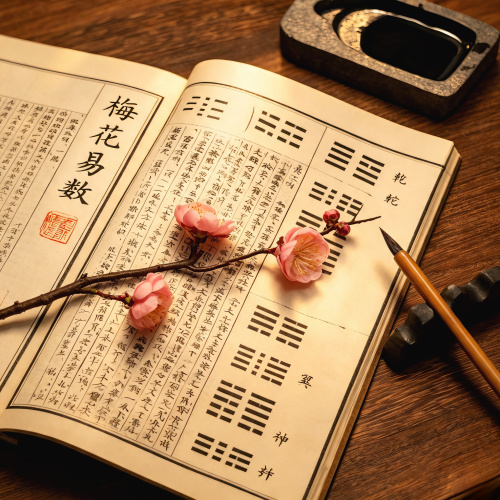
Hexagram symbols and classical texts provide a visual introduction to the language of the I Ching tradition.
Plum Blossom Numerology, Bazi, and Feng Shui: What Is the Difference?
Plum Blossom Numerology, Bazi, and Feng Shui are sometimes introduced together under the broad category of Chinese metaphysical traditions. Although they share concepts such as yin and yang, the Five Elements, and traditional cosmological correspondences, they do not perform the same function.
Plum Blossom Numerology: Interpreting Symbolic Patterns
Plum Blossom Numerology focuses on the formation and interpretation of hexagrams through the symbolic relationships of the I Ching. It is concerned with images, numbers, trigram combinations, and patterns of change. Its traditional methods often begin with a particular observation, number, or circumstance.
Bazi: Reading the Four Pillars of Destiny
Bazi (八字), also known as the Four Pillars of Destiny, uses the year, month, day, and hour of birth to construct a traditional chart. These four pillars are represented through the Heavenly Stems and Earthly Branches. Their relationships are interpreted through the Five Elements and other principles of Chinese cosmology.
Unlike Plum Blossom Numerology, which commonly begins with a specific question or observed circumstance, Bazi is structured around birth information and the traditional calendrical system.
Feng Shui: Understanding People and Their Environment
Feng Shui examines the relationship between people, buildings, landscapes, orientation, and the surrounding environment. Traditional approaches include the study of visible landforms and the use of directional systems and the Luopan compass.
Its central concern is the relationship between spatial conditions and the principles of environmental harmony. This makes Feng Shui different from both the symbolic interpretation of hexagrams and the birth-chart structure of Bazi.
Although these traditions developed through different methods, studying them together can help learners recognize how Chinese cosmological ideas were applied to different areas of life. They should nevertheless be understood as distinct systems rather than interchangeable techniques.
The Five Elements and Their Place in Traditional Interpretation
The Five Elements, or Wuxing (五行), are wood, fire, earth, metal, and water. They are better understood as five phases or modes of transformation than as five physical substances. Traditional Chinese thought uses them to describe relationships, cycles, and interactions within the natural world.
Each element is associated with a range of symbolic correspondences. Wood is connected with growth, fire with expansion and illumination, earth with centrality and nourishment, metal with structure and refinement, and water with storage and movement.
Two well-known relationships are the generating cycle and the controlling cycle. In the generating cycle, wood supports fire, fire produces earth, earth gives rise to metal, metal is associated with the collection of water, and water nourishes wood. In the controlling cycle, the elements regulate one another through a different set of relationships.
Within traditional metaphysical studies, these relationships provide an additional interpretive framework. They may be used alongside trigram symbolism, hexagram relationships, or Bazi chart analysis, depending on the system being studied.
For learners, the important point is not to memorize a list of symbolic associations without context. It is to understand how the Five Elements function as a connected model of relationships and change in traditional Chinese thought.
Why Study Plum Blossom Numerology Today?
Interest in Plum Blossom Numerology today is part of a wider international curiosity about the I Ching, Chinese philosophy, and traditional systems of symbolic interpretation. Some people approach it through classical texts; others are interested in the history of Chinese metaphysics or the relationship between different schools of traditional thought.
For a serious learner, the first step is to understand the cultural and intellectual foundations of the system. This includes becoming familiar with the Eight Trigrams, the structure of hexagrams, the idea of changing lines, and the historical development of image-number studies.
It is equally important to distinguish traditional interpretation from modern scientific knowledge. Plum Blossom Numerology belongs to the history of Chinese divination and symbolic thought. Its traditional claims should not be presented as scientifically established methods for predicting events, making medical decisions, or guaranteeing financial outcomes.
Approached as a subject of cultural study, however, it offers a valuable opportunity to explore how earlier Chinese thinkers understood the relationship between nature, time, symbols, and human experience.
Exploring Chinese Metaphysical Traditions at Funzendo
At Funzendo, located within Longmen Guanghua Temple in Luoyang, traditional Chinese culture can be explored through learning experiences that connect historical ideas with guided study.
The Feng Shui & Chinese Destiny Analysis Workshop introduces several related areas of traditional Chinese metaphysical knowledge, including Bazi, Plum Blossom Numerology, and Feng Shui. Its published curriculum includes the basic principles of Plum Blossom Numerology, symbolic and pattern analysis, and practical case studies.
The workshop also introduces the Four Pillars of Destiny, Five Elements theory, traditional Feng Shui approaches, and the use of the Luopan compass. These subjects offer learners different perspectives on the relationship between symbolic systems, time, personal charts, and the environment.
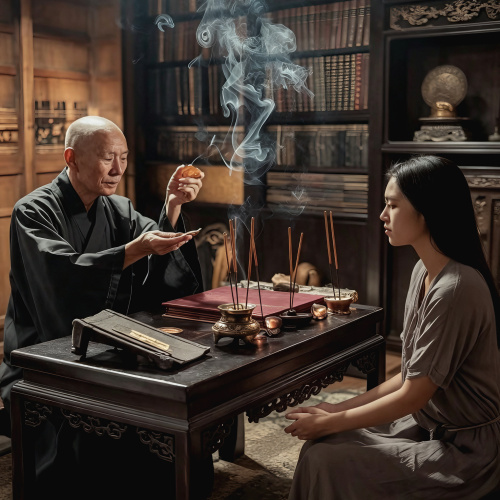
Traditional Chinese metaphysical studies bring classical texts, symbolic tools, and guided learning together.
For international participants, learning in a Chinese cultural setting provides an opportunity to encounter these traditions in the context from which they developed. Rather than treating every method as a shortcut to an answer, learners can examine the historical background, terminology, symbolic structures, and different interpretive approaches behind each subject.
Those interested in the relationship between Chinese spatial philosophy and the natural environment may also explore Chinese Feng Shui: Exploring Ancient Wisdom, I Ching and Harmony With Nature.
Frequently Asked Questions About Plum Blossom Numerology
Is Plum Blossom Numerology part of the I Ching tradition?
Yes. Plum Blossom Numerology is associated with the I Ching and its system of trigrams, hexagrams, and symbolic correspondences. It represents one of the later interpretive methods developed within the wider history of Chinese image-number studies.
Was Plum Blossom Numerology invented by Shao Yong?
Traditional accounts associate the method with Shao Yong, a Northern Song dynasty scholar known for his work on the I Ching. However, the authorship and compilation history of the surviving text are debated. It is more accurate to describe the work as traditionally attributed to Shao Yong while recognizing the complexity of its later transmission.
What is the difference between Plum Blossom Numerology and Bazi?
Plum Blossom Numerology traditionally interprets symbolic relationships through numbers, trigrams, and hexagrams. Bazi uses a person's birth year, month, day, and hour to construct a Four Pillars chart. Both draw on Chinese cosmological ideas, but their methods and structures are different.
Do I need prior knowledge of the I Ching to study Plum Blossom Numerology?
Prior knowledge is helpful but not essential for an introductory study. Beginners can start by learning the Eight Trigrams, yin-yang symbolism, the structure of hexagrams, and the basic relationships of the Five Elements before moving into more detailed interpretation.
Is Plum Blossom Numerology a scientifically proven prediction method?
No. It is a traditional Chinese divination and symbolic interpretation system, not a scientifically validated method for predicting future events. It is best approached through the history, philosophy, and cultural context of the I Ching.
Can international visitors study Plum Blossom Numerology in China?
International visitors interested in traditional Chinese metaphysical culture can explore the Feng Shui & Chinese Destiny Analysis Workshop at Funzendo. The published program introduces Plum Blossom Numerology alongside Bazi and Feng Shui. Visitors should contact Funzendo directly to confirm current availability, language arrangements, and booking details.